
Accreditation
ACADIX
Improving Schools. Empowering Students. Promoting Excellence.

About Acadix
Academic Accreditation Excellance (ACADIX) is an independent, voluntary membership organization that partners with over 300 public, independent, and international schools and colleges in the US and worldwide to assess, support, and promote high-quality education for all students through accreditation, professional assistance, and pursuit of best practices.
As a trusted provider of accreditation services, we are committed to promoting the highest standards of academic excellence and ensuring that students receive a quality education that meets the required standards.
ACADIX aspires to provide a process for meaningful, ongoing whole-school improvement while honoring the unique culture and context of each institution we support. Founded in 2016, ACADIX has a long tradition of school improvement across the six states of New England and in more than 85 countries around the world.
Today, ACADIX focuses on the accreditation of schools and colleges as a deeply mission-driven organization, is guided by key priorities which include advancing equity, promoting innovation and excellence in education, and empowering students.
The Process
Educational Quality
ACADIX is an advocate of educational quality and its ongoing improvement; it’s purposes are exclusively educational. It serves the public interest, the educational community, and the students within the educational system by:
- establishing and maintaining high standards of educational excellence
- providing a framework for institutional self-reflection and objective peer review
- serving as a resource and support for ongoing, meaningful whole-school improvement and growth.


ACADIX Accreditation
Grounded in the experience and expertise of practicing educators since 2016, ACADIX Accreditation is a respected, effective, and time-tested methodology for school improvement and growth. It is not a single event, but rather an ongoing, voluntary cycle of comprehensive internal and external assessments, short- and long-term strategic planning, and periodic reporting sustained by professional partnership and support. It is intended to serve as a framework for schools to meet their own unique goals for student learning while maintaining alignment with research-based Standards for Accreditation that define the characteristics of high quality, effective learning communities. It also serves to assess the systems in place for ongoing institutional self-reflection and a school’s commitment to and capacity for continuous growth and/or transformation.
“Accreditation is founded on the principle that comprehensive self-reflection followed by candid feedback from professional peers is essential to ongoing school improvement and achieving educational success. Guided by research-based standards, which are periodically reviewed and revised by leading New England educators, accreditation provides a clear direction for school communities striving to ensure their students receive outstanding educational experiences.”
– Cameron C. Staples, President/CEO of ACADIX
The Process
The Ongoing Cycle of Accreditation
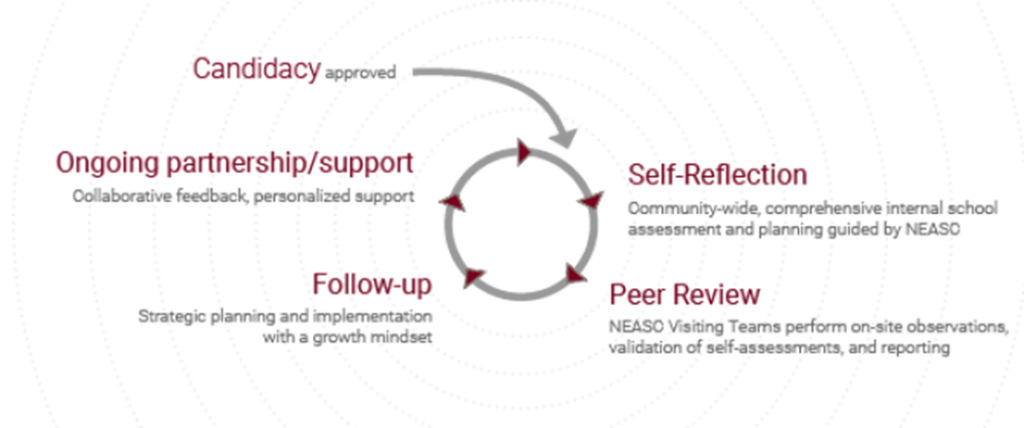
Accreditation is not a single event, but rather an ongoing, voluntary cycle of comprehensive internal and external assessments, short- and long-term strategic planning, and periodic reporting sustained by professional partnership and support. Member schools must periodically demonstrate continued alignment with ACADIX Standards in order to maintain their ACADIX Accreditation/Membership.
The Process
Phases of ACADIX Accreditation
Accreditation is structured in three main phases:
1. Reflection
Member institutions undergo a rigorous and comprehensive Self-Reflection. The process engages the entire educational community — faculty, administrators, staff, students, community members, and board members — in structured analysis, self-assessment, and planning in response to the Standards of Accreditation.
3. Renewal
Follow-up
Following receipt of the Visiting Team report(s), school personnel then respond to recommendations stated in the Visiting Team Report by designing and implementing short- and long-range plans for improvement and growth. Strategic planning and regular follow-up reports are monitored by a commission of elected peers and overseen by a professional staff to ensure that goals and recommended institutional improvement can be accomplished.
2. Review
Each year volunteers contribute 250,000+ combined hours of their time to conduct professional peer reviews — the heart of ACADIX Accreditation. Trained volunteers from the educational community work together as a team to visit each school undergoing an accreditation review to conduct on-site, objective assessments. These “Visiting Teams” evaluate the school’s alignment with the appropriate commission standards — a process that includes observations of teaching and learning, conducting interviews, reviewing reports by and about the school, validating the school’s self-reflection, identifying areas of strength, and making recommendations to assist with better alignment with the Standards, school improvement, growth, and future planning.
The Process
Ongoing partnership/support
Additional personalized support and/or intervention is provided, as necessary, to respond to information gathered through collaborative feedback and regular reports from the institution or through comments from the public concerning a failure to comply with the Standards. The ACADIX Commissions are authorized to conduct on-site evaluations at shorter intervals if institutional circumstances so dictate.

Getting Started
A school interested in accreditation begins by applying for candidacy and must demonstrate that it has the basic structures, policies, and systems in place to support a quality learning environment. Once a school has been recognized as a ACADIX Candidate for Accreditation, the cycle commences. The nature and timing of reviews and other assessment tools guided by the various ACADIX accreditation protocols may vary, but all have at their core a rigorous and comprehensive self-reflection process followed by an on-site evaluation conducted by a team of trained peers from the educational community, follow-up reporting*, strategic planning, implementation, and ongoing personalized support.
* Because each school is reviewed based upon its unique characteristics and applications of the ACADIX Standards, no two peer review reports will be alike.